Zrok
Zrok is an open-source peer-to-peer tunneling and ingress service from NetFoundry, built on the OpenZiti zero-trust network. It lets you securely share local applications, files, and web content, either privately or publicly.
Alternatives
Tech stack
No tech stack added yet. Sign in to suggest some
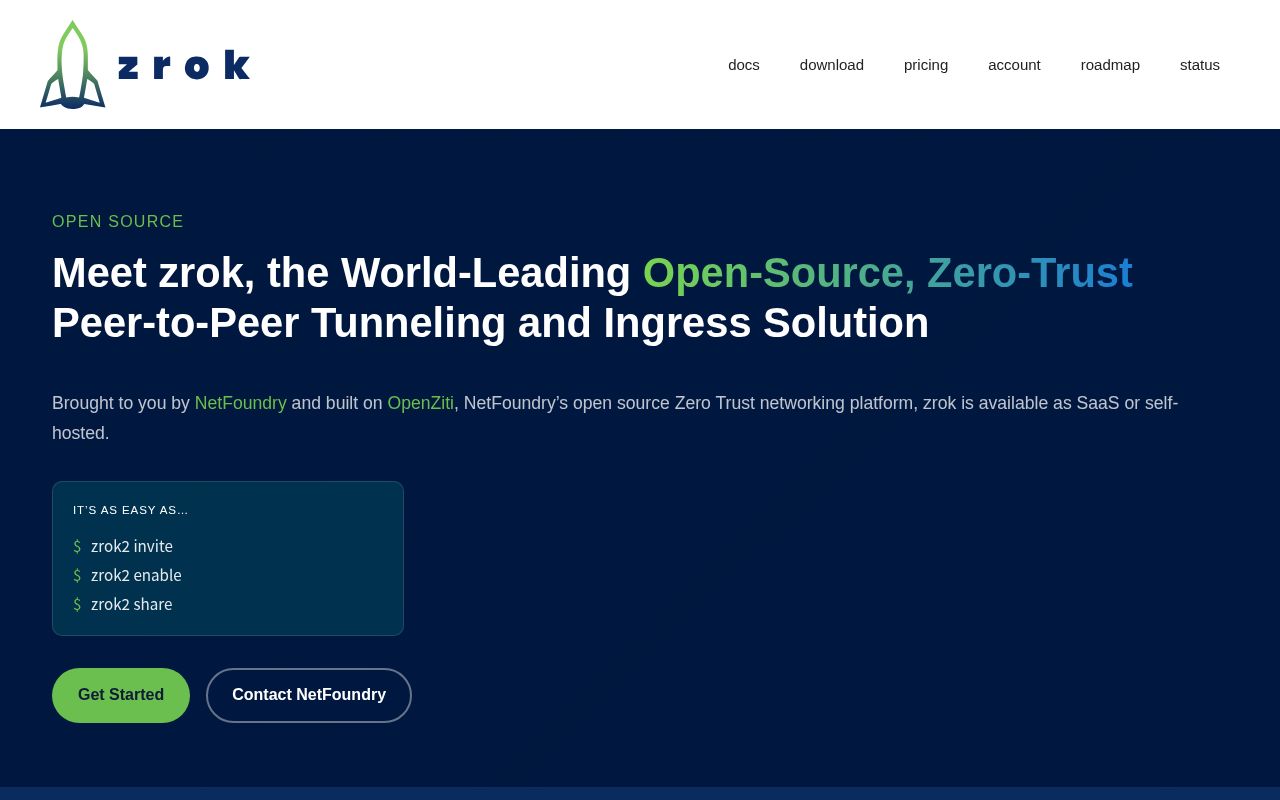
Zrok is made by NetFoundry and built on OpenZiti, its open-source zero-trust networking platform. The official website positions it as an open-source, zero-trust peer-to-peer tunneling and ingress solution. You can use the official hosted SaaS service or deploy it yourself.
Key Features
- Private sharing: Share resources privately between zrok users. In private scenarios, resources are not exposed on any public endpoint, and communication is encrypted only between zrok clients.
- Public sharing: Publish a local application through a public ingress for instant, secure tunnel access.
- More than an HTTP proxy: Besides proxying HTTP endpoints, you can also easily share files and web content. The website says the framework is extensible and can be used to support a wider range of decentralized resource sharing.
- Zero-trust foundation: Security is provided by the zero-trust overlay network from OpenZiti.
- Public service or self-hosted: zrok.io is the public service instance operated by NetFoundry, and it runs the same code as the self-hosted version.
Target Users and Use Cases
- Developers who need to temporarily expose a local service to colleagues or clients for demos and testing.
- Operations staff and individual users who need secure access to services on a home or internal network without opening public ports.
- Teams that want to set up a controlled tunneling and sharing service on their own infrastructure.
- Situations where files or web content need to be shared privately between users.
Core Strengths
- Easy to get started: the website describes a process of just three steps.
- Flexible deployment scale: the website says it can scale up to very large service instances or down to very small deployments, for example running an OpenZiti network on a Raspberry Pi with zrok layered on top.
- A single zrok binary contains everything needed to run a zrok environment and host your own service instance. For self-hosting, you also need a Ziti network.
- Open source, and the website states that it is free to use.
Quick Start
Download the binary for your platform from the website or GitHub Releases, then run the following in order:
zrok2 invite: Create an account on the service.zrok2 enable: Enable sharing for the current shell environment.zrok2 share: Share resources securely right away.
Technical Requirements and Notes
- Using the official SaaS requires creating an account through the invitation process first.
- Self-hosting requires an existing OpenZiti network, on top of which you deploy the zrok service instance.
- The website provides pages for documentation, downloads, pricing, account management, the roadmap, and service status. The open-source code is hosted in the openziti/zrok repository on GitHub. For specific plans and limits, please refer to the pricing page on the website.
Discover more
Cloudflare Tunnel
Cloudflare Tunnel runs a lightweight daemon, cloudflared, on your server and opens an outbound-only, post-quantum encrypted connection to Cloudflare. This lets you securely publish origins, APIs and internal services to the internet without a public IP or any open inbound ports.
Ngrok
ngrok is a developer infrastructure platform that routes and secures traffic to apps, APIs, and AI models, no matter where they run. It can expose a local app to the public internet in one step, and it can also serve as an API gateway and AI gateway in production.
Tailscale Funnel
Tailscale Funnel is a Tailscale feature. It routes internet traffic to a local service running on a device in your tailnet, so people who don't have Tailscale installed can reach it through a public Funnel URL.

ChartDB
A powerful open-source database diagram editor that requires no installation and no database password, letting you visualize your database schema with a single query
DNS Benchmark
A batch DNS server benchmarking tool that locally measures the reachability and performance of DNS servers around the world and generates visual charts
LiteXiv
A free frontend for pixiv that is simple yet sufficient.