
PowerContext
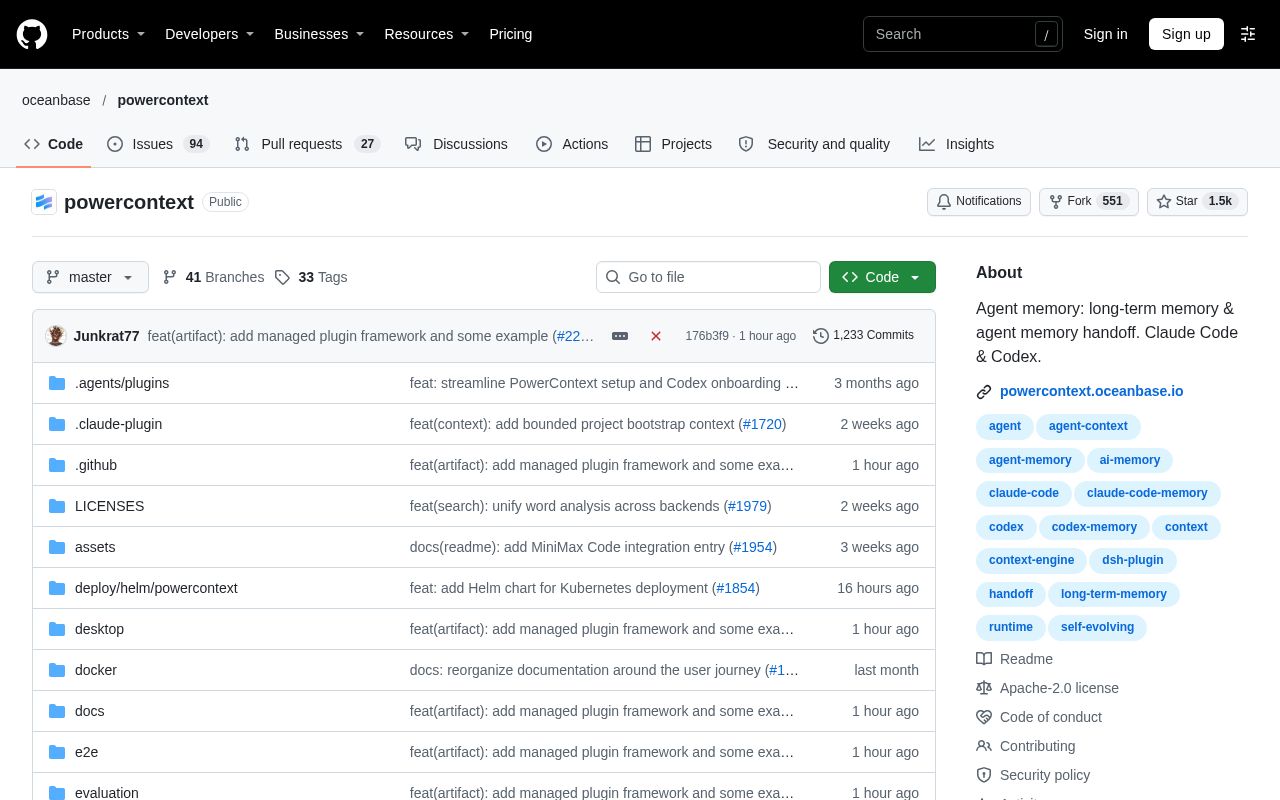
PowerContext is OceanBase's open-source context service for AI agents. It keeps long-lived information such as decisions, constraints, evidence, and progress outside any single conversation. The next session, the next agent, or the next person can pick up from the current state without rereading chat history.
Alternatives
Tech stack
No tech stack added yet. Sign in to suggest some
PowerContext is OceanBase's open-source context service for AI agents. It keeps the parts of the work that need to last (decisions, constraints, evidence, progress) outside any single conversation, stored as versioned, inspectable Artifacts. When a session ends, an agent is switched, or work is handed to someone else, the receiving side can continue from the current state without rereading the whole conversation record. The project is the successor to PowerMem and is licensed under Apache-2.0.
Key features
- Memory: Stores reusable decisions, constraints, facts, state, and next steps. Entries have one of the states active, forgotten, merged, or retired. Forgotten entries drop out of active recall, but their content and history can still be viewed and restored. Writing memory explicitly does not require a model; automatic extraction from captured Sources requires a configured generation pipeline.
- Handoff: Records work continuity in four steps: "work contract → prepared handoff → confirmation → task result." The receiving side parses the handoff content and sends an acknowledgment, and the task result is kept as Source evidence. The Handoff Report is a read-only view of the latest version in each Scope and never rewrites Memory.
- Experience: Records the situation, the action taken, the observed result, and a reusable lesson. An experience first enters the review inbox within its Scope as a candidate; only after approval is it written as an immutable version and made available for recall.
- Skill: A hosted, reusable procedure with a name, discovery description, instructions, validation items, and provenance. Approval is not installation or execution: a specific version must be explicitly exported before an agent host can discover it.
- Bounded recall:
PreparedContextselects configured fragments from active memories and approved experiences, optionally adds a Profile snapshot and topic memories, then trims everything to a unified byte budget and returns either ready or empty. Recalled content is historical reference only and carries no instruction authority. - Versioning and traceability: Every Artifact is addressed as
FAMILY/ARTIFACT_ID@REVISION, and reading a specific revision returns the historical snapshot from that time. - Scope isolation: Each Scope has its own Source log, memory lifecycle, review inbox, and handoff history. A Scope ID is only used to select data; it does not represent authentication or authorization to execute anything.
Target users and use cases
It suits developers and teams who regularly use coding agents such as Claude Code and Codex, especially when they need to keep project constraints across sessions, switch between different agents, or hand an in-progress task to a colleague. It can also be embedded as a service in your own agent applications.
Integration
- Provides an HTTP API, MCP, a Python Client, a command line, and a Dashboard, along with plugins for agents.
- The official README lists these hosts and frameworks: Codex (officially supported), Claude Code, MiniMax Code, DeepSeek Harness, ZCode, Kimi Code, Hermes Agent, Pi Coding Agent, OpenClaw, OpenCode, WorkBuddy, Bub, and Python frameworks such as Pydantic AI, LangChain, and LangGraph. Apart from Codex, which is official, most are community-level, and Bub is only at the evaluation level.
- Applications can also use the in-process Core SDK to assemble their own implementation from the three core protocols: Source, Artifact, and Trigger.
Installation and deployment
- Requirements: Python 3.11+, Git, and uv (uv can provide Python when needed). To connect an agent, you also need to install the corresponding CLI. macOS and Linux are supported; Windows support is currently experimental.
- Example install command:
uv tool install --force "powercontext[cli,server]==1.4.1", then runpowercontext config initto start the interactive setup wizard, and start the service withpowercontext server run --env-file .env. - The wizard offers two modes. Basic memory is for explicit saving and recall and needs no model API. Full memory processes Sources automatically and supports topic memories and semantic search; it requires separately configured API credentials for a generation model and an embedding model.
- For storage, the wizard recommends SQLite as the simplest way to start, and embedded seekdb is also available.
- For Kubernetes deployment, you can use the Helm chart in the repository to connect to an external OceanBase.
- The repository provides Jupyter tutorials, the first seven of which need no model or API key.
Worth noting
- Generation, review, and execution are separate steps. A model proposes content, a reviewer approves a version, and an export produces a local copy for the host; none of these steps grants an agent permission to execute instructions.
- Self-reported benchmark results from the project: 90.78% accuracy on LoCoMo; in paired project runs on SWE-bench Pro, the task resolution rate was 86.73% with it enabled versus 82.35% with it disabled (not an official submission). The README also states that the LoCoMo Plus score was provided by the project team and the run artifacts have not been published, so it cannot be verified.
Discover more
Cindy
Cindy is an open-source AI agent app that connects your computer and phone, so you can use agent frameworks such as Claude Code, Codex and Pi, along with a wide range of models, all in one place. It supports cross-device access to tasks, files and models, as well as remote desktop takeover, with no need to set up your own server.

Aider
aider is AI pair programming in your terminal

Cline
Autonomous coding agent as an SDK, IDE extension, or CLI assistant.

Cody
Type less, code more: Cody is an AI code assistant that uses advanced search and codebase context to help you write and fix code.

Continue
open-source coding agent
Executor
Executor connects the accounts and tools you use to the AI agents you already work with, through a single MCP server. Your agents can also build custom tools, automations, storage and interfaces on top of those connections.