

Steemit
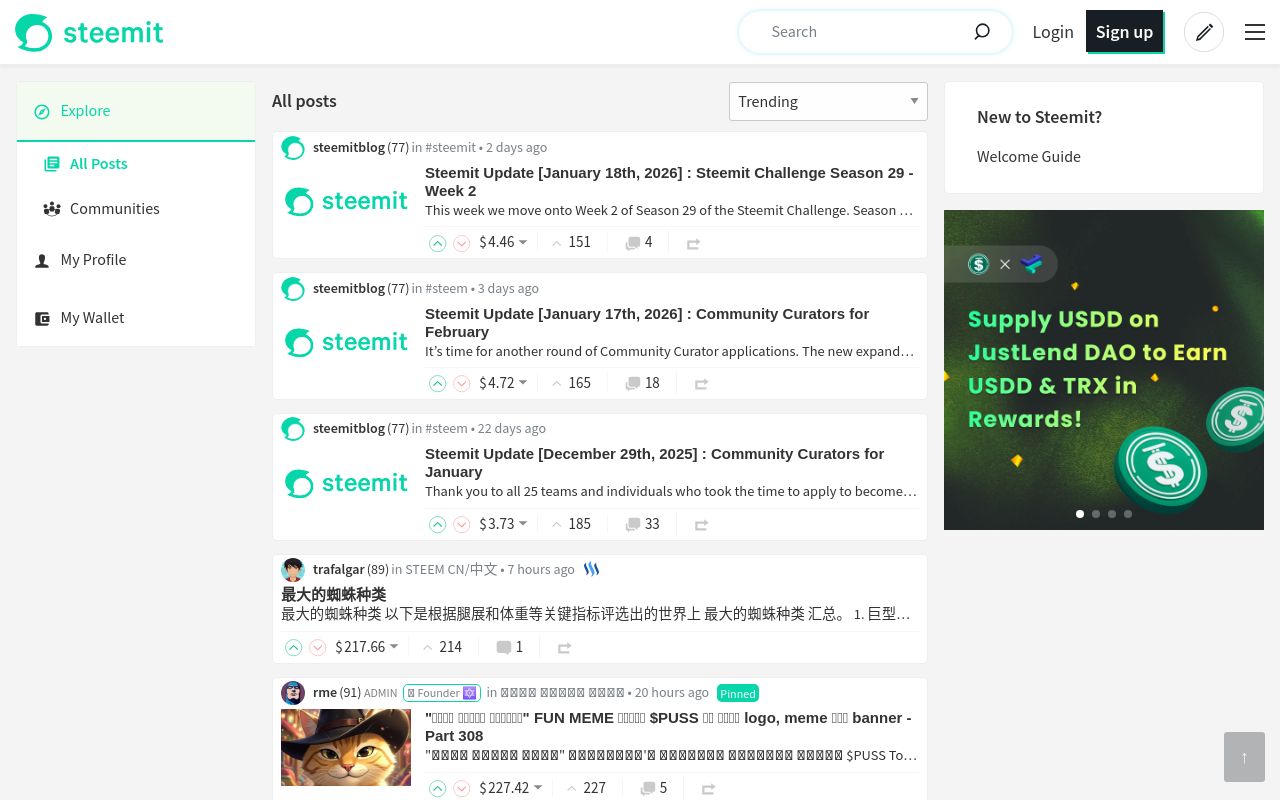
Steemit is a blockchain-based social media platform that lets users earn cryptocurrency rewards by publishing and curating content. It launched on July 4, 2016, and was founded by Ned Scott and blockchain developer Daniel Larimer, who is best known for creating the DPoS consensus mechanism. Unlike centralized platforms such as Facebook and Twitter, Steemit runs on a decentralized blockchain called Steem.
Alternatives
Tech stack
No tech stack added yet. Sign in to suggest some
Steemit in Detail
Platform Overview
Steemit is a blockchain-based social media platform that lets users earn cryptocurrency rewards by publishing and curating content. It launched on July 4, 2016, and was founded by Ned Scott and blockchain developer Daniel Larimer, who is best known for creating the DPoS consensus mechanism. Unlike centralized platforms such as Facebook and Twitter, Steemit runs on a decentralized blockchain called Steem.
The platform's core idea is to change the content creator economy through economic incentives: users earn tokens by creating content, upvoting (voting) and commenting. This model is called "Proof of Brain", in which the community decides through voting which content deserves rewards.
The Three-Token System
The Steemit ecosystem revolves around three distinct tokens:
| Token | Function | Description |
|---|---|---|
| STEEM | Main trading token | Used for trading, transfers and witness voting; price is volatile |
| Steem Power (SP) | Governance and influence | Represents influence in the community; holding more SP means more voting power |
| Steem Dollars (SBD) | Stablecoin | Pegged to the US dollar (1:1 ratio); offers stability and 10% annual interest |
The "Power Up" mechanism is a key feature of Steemit: users can convert STEEM into Steem Power, locking it for 13 weeks. This increases a user's voting power in the network and also prevents price crashes caused by large-scale selling.
How the Reward System Works
Steemit rewards participants through a carefully designed incentive structure:
Distribution ratio:
- 75% of newly generated tokens go to content creators and curators
- 15% go to Steem Power holders
- 10% is paid to witnesses (network validators)
Post reward process: After a user publishes content, the post can earn rewards during its first 7 days. The author receives:
- 50% of the reward paid in Steem Power
- 50% paid in Steem Dollars, STEEM, or a combination of both
Curation rewards: Users who vote/upvote receive 25% of the total post reward as curation rewards, all paid in Steem Power. This encourages users to find and support high-quality content. The earlier a user votes for a post that eventually becomes popular, the higher their curation rewards.
Inflation control: STEEM's initial annual inflation rate was close to 100% (doubling every year). Under community pressure, this was adjusted to an annual inflation rate of 9-9.5%, with a plan to reduce it by 0.5% each year until it reaches 0.95% after 20 years.
Technical Architecture: Delegated Proof of Stake (DPoS)
Steemit uses an innovative consensus mechanism called Delegated Proof of Stake, developed by Larimer in 2014. The system works through elections:
How it works:
- Token holders vote to elect 20 witnesses (block validators)
- These witnesses validate transactions and create new blocks
- Witnesses are rewarded for maintaining the network, and these rewards are distributed automatically on-chain
- Users can vote directly or delegate their voting power to others
Key advantages:
- High performance: Historically, Steem has processed more transactions than Bitcoin and Ethereum combined
- Free transactions: Smart bandwidth allocation makes transactions free
- Fast confirmation: A new block is produced every 3 seconds, 24/7
- Democratization: Even small holders can become witnesses if they receive votes from large holders
Platform Activity and Current Status
As of early 2025-2026, Steemit is still active but has a limited user base:
| Metric | Value | Description |
|---|---|---|
| Daily new posts | ~2,675 | Root posts (new discussion threads) |
| Daily votes | ~90,486 | Community engagement metric |
| Daily comments | ~4,117 | Frequency of user interaction |
| Daily transfers | ~11,343 | Token transfer activity |
| Average TPS | 1.38 | Transactions per second |
Token price and market cap:
- Current price: ~$0.067 USD
- Circulating supply: 537-540M tokens
- Market cap: ~$35-62M USD
- All-time high: $8.19 (January 2018)
- Market rank: 540-707 (by market cap)
This reflects a huge drop in value since the 2018 bear market.
The 2020 Justin Sun Incident and the HIVE Fork
What Happened
On February 14, 2020, an event with far-reaching consequences for the Steemit ecosystem took place:
- TRON founder Justin Sun acquired Steemit Inc. and gained a large amount of STEEM tokens
- These tokens included the controversial "ninja mine" (ninja stake): pre-mined tokens set aside early on for development purposes
- Sun's transactions were supported through exchanges, raising questions about genuinely decentralized governance
Community Reaction and the Fork
The community strongly opposed the move:
- On February 23, witnesses carried out a "soft fork" to freeze the voting power of Steemit Inc.
- Sun's side claimed the move was "malicious and potentially illegal"
- The community was unable to reconcile the differences, which ultimately led to a hard fork
The Birth of HIVE
In March 2020, the HIVE blockchain was born as a direct response to Steem:
| Feature | Steem | HIVE |
|---|---|---|
| Background | The original platform, later acquired by Justin Sun | Forked by the community in response to centralization |
| Fund management | Controlled by a single entity (Steemit Inc) | Uses the Decentralized Hive Fund (DHF) |
| Token mapping | 1:1 ratio | HIVE maps 1:1 to STEEM |
| Development status | Relatively stagnant, influenced by Sun | Active development, 30+ contributors |
| Community consensus | Decided by community vote | Decentralized voting system with no single veto power |
Key improvements in Hive:
- Decentralized Hive Fund (DHF): Replaces the ninja stake, allowing users to propose, vote on and receive community funding
- No single controller: Ensures that no individual or entity can veto community decisions with a single vote
- Time-locked funds: Prevents market flooding, as funds are released slowly
The community generally regards HIVE as the "true" layer 0 blockchain, while STEEM is seen as more centralized.
Ecosystem and DApps
Steemit's strength lies in the ecosystem built around the Steem blockchain:
Main applications:
- DTube: A YouTube-like video platform that can publish to HIVE, Steem and Blurt at the same time
- Ecency, PeakD: Alternative UIs with an improved user experience
- LeoFinance: A dedicated financial content platform
- Other applications: 300+ dApps are built on Steem or HIVE
These applications interact seamlessly with the main chain, demonstrating the flexibility of a blockchain database.
Main Advantages
- True ownership: Content is stored on the blockchain and fully owned by users
- Direct monetary incentives: Unlike the advertising model of traditional social media, Steemit rewards users with cryptocurrency
- Censorship resistance (especially on HIVE): No central entity can delete posts or accounts
- Community governance: Users vote to choose the direction of the platform and its validators
- Fast transactions: Smart bandwidth allocation enables free, fast transactions
- Multimedia support: Supports multiple content formats, including text, images and video
Key Challenges and Limitations
1. Whale Dominance
Although DPoS promises democratization, Steemit still suffers from the whale problem:
- Users holding large amounts of Steem Power have disproportionate control over voting and governance
- At least 7,000 SP is needed to have a meaningful influence on governance
- This excludes small participants and reintroduces centralization
2. Vote Trading and Bot Manipulation
The platform's most serious problem is abuse of the system:
- Users can buy upvotes to artificially inflate the value of a post, regardless of quality
- A culture of "vote trading" has emerged, in which users swap votes for mutual benefit
- Bot manipulation undermines the ideal of genuine engagement
- This damages the entire reward mechanism, favoring those with financial resources
3. Token Inflation and Unsustainable Economics
Steemit faces fundamental economic challenges:
- The continuous creation of new tokens dilutes the value of existing tokens
- If the blockchain's growth cannot keep pace with inflation, the system becomes unsustainable
- This pushes token prices down and reduces content creators' real income
- The fall from the 2018 high of $8.19 to the current $0.067 reflects this problem
4. Limited Liquidity and Exchange Support
- STEEM is listed on a limited number of exchanges, with shallow trading depth
- This makes large withdrawals difficult and increases slippage risk
- HIVE's liquidity is even worse, limiting its growth
5. Stagnant User Growth
- After the surge of active users in 2017, retention has been poor
- Many new users find the rewards negligible and are unable to change the platform's direction
- The community split (STEEM vs HIVE) has further fragmented the user base
6. Limited Practical Value Proposition
- It is unclear why users would participate in the long term for any reason other than making money
- Compared with engagement on true social media platforms, Steemit adoption remains very low
- Mining farms and spam content continue to be problems
Latest Developments in 2025-2026
The platform is trying to address these challenges:
Steemit Challenge Season 29:
- Launched in late 2025, designed to promote the sharing of practical skills
- 13 million Steem Power will be distributed to participating teams
- Emphasizes education-focused content creation
Community curation app program:
- Aims to decentralize governance by distributing a large amount of SP to 11 teams
- These teams are responsible for discovering high-quality content
These initiatives show that the platform recognizes the need to address centralization and to incentivize genuine participation, but whether they succeed remains to be seen.
Value Proposition and Use Cases
Who Should Use Steemit?
Content creators:
- Those who want to be paid directly by their audience (without ads)
- Those with expertise they want to share (especially educational content on HIVE)
- Creators seeking a high degree of transparency
Crypto enthusiasts:
- Those interested in decentralized social media
- Those who want to participate deeply in DPoS governance
- Validators and witness candidates
Investors:
- Those seeking long-term investment in Web3 infrastructure
- Those with a high risk tolerance (the token is highly volatile)
Where It Is Not a Good Fit
- Mainstream entertainment: It doesn't have a user base on the scale of TikTok or YouTube
- High-frequency trading: Liquidity is too low and trading costs are unclear
- Getting rich quick: Although some people make money, meaningful returns require a substantial investment
- Those seeking uncensored content: Although censorship resistance is strong, it also means there is no content moderation
Conclusion
Steemit represents a bold experiment: using crypto token incentives to change the content creator economy. At its best (especially on HIVE), it demonstrates the possibilities of truly decentralized social media.
However, practice has shown that this model has critical problems: whale dominance limits genuine democratization, imbalances in tokenomics cause sustainability problems, and vote trading makes honest participation difficult.
The platform's survival depends on whether it can:
- Genuinely decentralize power through mechanism reform
- Build sustainable tokenomics
- Attract and retain genuine content creators (rather than speculators)
- Overcome liquidity limitations
For those looking to get involved, the key is to understand that Steemit remains a high-risk, high-reward proposition. For most users the earnings are negligible, but for certain niche communities and deeply involved participants, it may still be a meaningful platform.
Main references: Wikipedia, CoinMarketCap, GitHub Steem, Harvard Business School case study, CryptoBriefing, official Steemit blog, multiple ecosystem analyses
Discover more
BiliNote
BiliNote is an open-source AI video note generator that helps users quickly turn videos from platforms such as Bilibili, YouTube, and Douyin into structured Markdown notes.
Claude Code Usage Monitor
A tool to track and monitor code generation usage of Claude, providing insights into performance, efficiency, and cost.
Ego lite Browser
ego lite is a browser shared by users and AI agents. Agents such as Claude Code and Codex run web automation tasks in separate Spaces, so they never take over your own tabs, and they can reuse the logged-in state of your browser.
Nudge
GitHub to-dos in your macOS menu bar
OneFolderApp
OneFolderApp is an open-source image management tool.

OpenScreen
OpenScreen is an open-source screen mirroring and remote control solution allowing users to display and interact with one device's screen on another.