
Tantivy
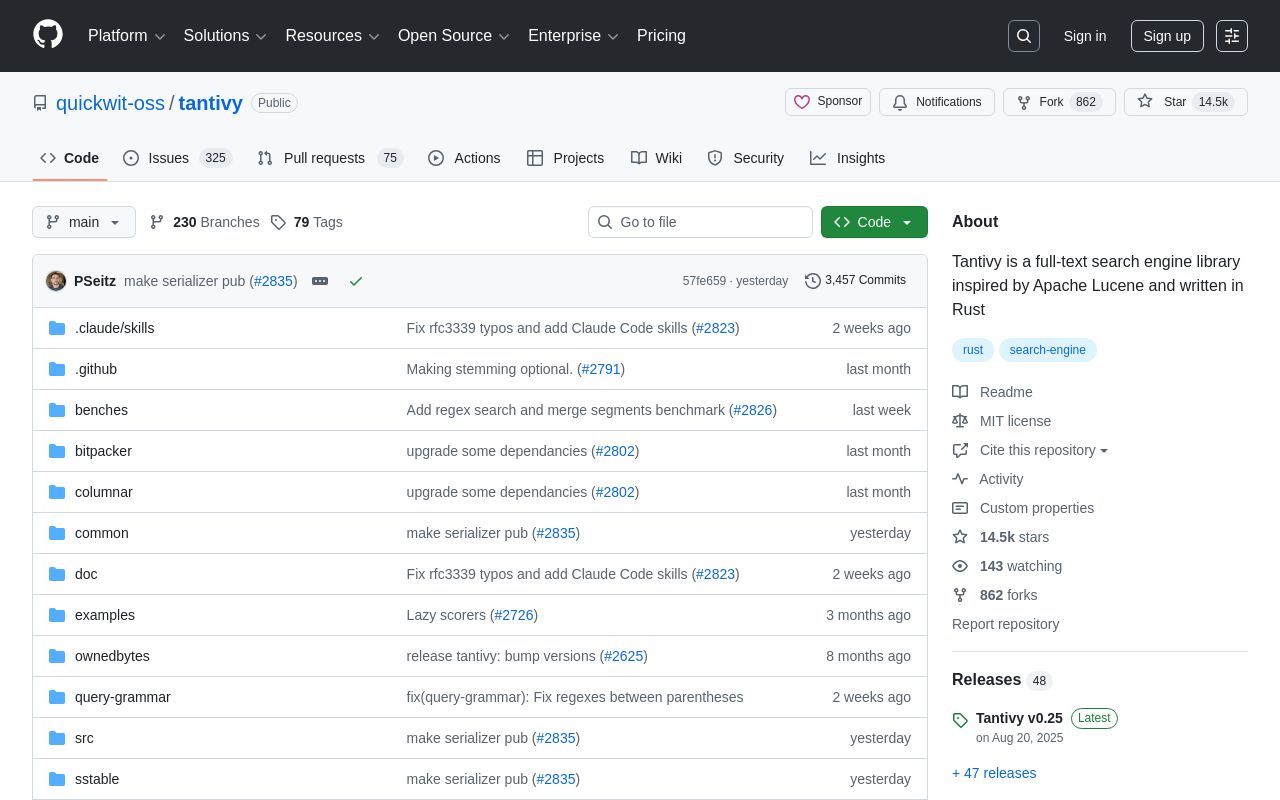
`tantivy` is a **full-text search engine library written in Rust**. You can think of it as "Lucene for Rust." In short: - It's used for **full-text search** (keyword search, relevance scoring and ranking, inverted indexes) - It is not a complete search service (it isn't an out-of-the-box server like Elasticsearch), but an **embeddable library** - It's a good fit for building search into your own application, with strong performance and controllable resource usage Common use cases: - Document search - Log search - Site search - Systems that need a high-performance local index Relationship with Quickwit: - Quickwit (a log search engine) uses Tantivy under the hood as one of its core indexing components.
Alternatives
Tech stack
No tech stack added yet. Sign in to suggest some
Note: We were unable to fetch the official website this time, so the content below is compiled from existing knowledge of the project. Please refer to the GitHub repository and documentation for specifics.
Overview
Tantivy is an open-source full-text search engine library written in Rust. It is maintained by the Quickwit team (quickwit-oss) and its design draws on Apache Lucene from the Java ecosystem. It is not a standalone search server like Elasticsearch or Solr, but a low-level component that developers embed in their own programs, playing the role that Lucene plays in the Java world, but for Rust.
Many higher-level projects use Tantivy as their indexing and retrieval core, such as Quickwit, a cloud-native log search engine, and ParadeDB, which provides full-text search in PostgreSQL.
Key Features
- Full-text search and relevance ranking: Uses BM25 relevance scoring, the same as Lucene.
- Rich query types: Supports natural query syntax parsing, boolean queries, phrase queries, range queries, and more.
- Tokenization and multilingual support: Includes configurable tokenizers, supports stemming for many languages, and can also integrate third-party tokenizers (such as Chinese and Japanese tokenizers).
- Fast fields: Column-oriented fields used for sorting, filtering, and aggregation.
- Faceted search and aggregations: Supports facet counts, as well as Elasticsearch-style aggregation analytics.
- JSON fields: Can index semi-structured JSON data directly.
- Incremental and multithreaded indexing: Supports incremental writes and uses multiple threads to speed up index building.
- Compact storage: Posting lists and document storage are both compressed, keeping index size small.
- Fast startup: Based on memory mapping (mmap), indexes open very quickly, which suits command-line tools and short-lived processes.
Target Users and Use Cases
- Developers who need to embed search in Rust applications
- Teams that want to build their own search service, log search system, or database search extension
- Desktop and command-line tools that need offline or local full-text search
- Projects that want a search core that uses fewer resources than JVM-based solutions to replace Lucene
Core Strengths
- High performance: Implemented in Rust with no GC pauses, so both indexing and querying are fast.
- Embedded: Integrates directly as a library, with no need to deploy and operate a separate search cluster.
- Close to Lucene in features: Covers most of the commonly used full-text search capabilities.
- Active ecosystem: Used and driven over the long term by production-grade projects such as Quickwit, and the community also provides a Python binding (tantivy-py), among others.
- Permissive license: Licensed under MIT, so it can be safely used in commercial projects.
Installation and Usage
Tantivy is published as a Rust crate. Just add it as a dependency in your project's Cargo.toml:
[dependencies]
tantivy = "*"  # 建议改为 crates.io 上的具体版本号
Basic workflow:
- Define a Schema (fields and their indexing and storage options)
- Create or open an index directory
- Add documents with an IndexWriter and commit
- Run queries using an IndexReader / Searcher together with a QueryParser
The repository includes several example programs, and the official documentation is published on docs.rs.
Technical Requirements
- Requires the Rust toolchain (Cargo)
- Supports mainstream operating systems
- The index is stored in a local disk directory; an in-memory directory can also be used
Worth Noting
- Tantivy is only a library and ships with no HTTP API, distributed cluster, or management UI. If you need a ready-made search service, take a look at Quickwit, which is built on it, or alternatives such as Meilisearch.
- CJK languages such as Chinese require integrating an appropriate tokenizer plugin.
Discover more

Orca
[Orca](https://www.onorca.dev/) is a desktop Agent Development Environment (ADE) built for the AI era. It is developed by Lovecast Inc., a San Francisco startup backed by Y Combinator, and released as open source under the MIT license. Orca's core idea is to shift the design center of the traditional IDE from "a single human developer" to "a human plus a fleet of AI agents." Users can run more than 25 AI coding agents at the same time, including [[Claude Code]], [[Codex]], Gemini, GitHub Copilot and OpenCode. Each task gets its own isolated [[Git Worktree]], which makes truly parallel development possible. Orca itself does not provide any AI models; users bring their own subscriptions (Bring Your Own Subscription) to connect the AI services they already use.
clipse
A clipboard manager with a terminal user interface (TUI)
ish
iSH is a Linux shell environment that runs directly on iOS devices, enabling users to execute Linux commands and applications on their iPhones and iPads without jailbreaking.
Whispering
Whispering is a transcription service within the Epicenter project, converting audio to text.

Codex
A software development tool from OpenAI.
HAJIMI Gemini API Proxy
HAJIMI Gemini API Proxy is a lightweight proxy server that makes it easier and more flexible to access the Google Gemini API, with features such as authentication and rate limiting.