
Puppeteer
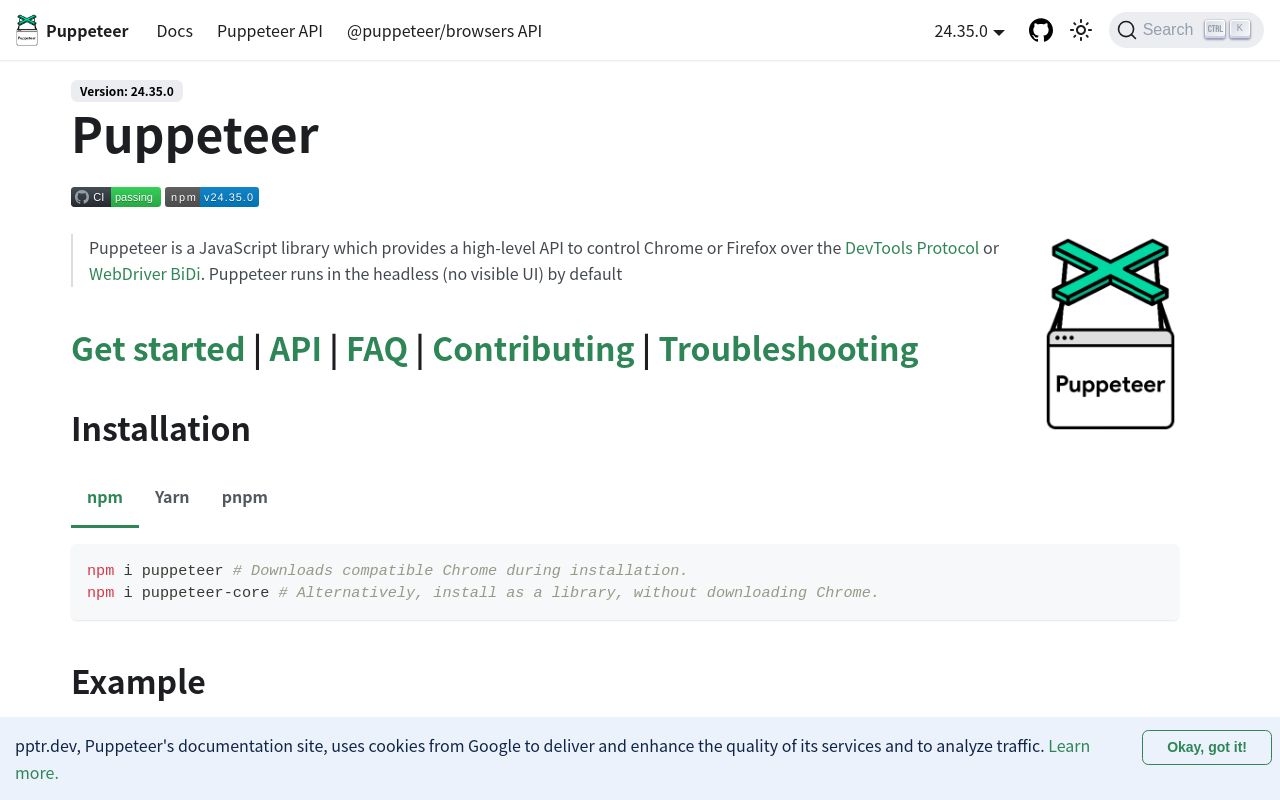
Puppeteer is a Node.js library developed by the Google Chrome team that controls headless Chrome or Chromium browsers through the DevTools protocol.
Alternatives
Tech stack
No tech stack added yet. Sign in to suggest some
Puppeteer is a Node.js library developed by the Google Chrome team that controls headless Chrome or Chromium browsers through the DevTools protocol.
Key Features
It supports taking page screenshots, generating PDFs, crawling single-page applications (SPAs), automating form submission and UI testing, and capturing performance timelines. It runs in headless mode by default, but can be configured to run in headful mode for easier debugging. It is also suitable for testing Chrome extensions and creating automated testing environments that use the latest JavaScript features.
Installation and Usage
Install it with npm or pnpm: pnpm add puppeteer, which automatically downloads a Chromium binary.
A basic example launches a browser, navigates to a page and extracts its title, and it supports listening to request/response events.
Core Architecture
Puppeteer manages sessions and tabs through a hierarchy of Browser, BrowserContext and Page, with each Page corresponding to a Frame execution context. It emphasizes speed, security and stability, and compared with PhantomJS or Selenium, it is easier to use and specifically optimized for Chromium.
Discover more
Playwright
Playwright is an open-source browser automation framework developed by Microsoft, used mainly for web testing, web scraping, and automation. It supports major browser engines such as Chromium, Firefox, and WebKit, runs cross-platform (Windows, Linux, macOS), and offers bindings for multiple languages, including Python, JavaScript, Java, and C#.
BiliNote
BiliNote is an open-source AI video note generator that helps users quickly turn videos from platforms such as Bilibili, YouTube, and Douyin into structured Markdown notes.
Claude Code Usage Monitor
A tool to track and monitor code generation usage of Claude, providing insights into performance, efficiency, and cost.
OneFolderApp
OneFolderApp is an open-source image management tool.

OpenScreen
OpenScreen is an open-source screen mirroring and remote control solution allowing users to display and interact with one device's screen on another.

Orca
[Orca](https://www.onorca.dev/) is a desktop Agent Development Environment (ADE) built for the AI era. It is developed by Lovecast Inc., a San Francisco startup backed by Y Combinator, and released as open source under the MIT license. Orca's core idea is to shift the design center of the traditional IDE from "a single human developer" to "a human plus a fleet of AI agents." Users can run more than 25 AI coding agents at the same time, including [[Claude Code]], [[Codex]], Gemini, GitHub Copilot and OpenCode. Each task gets its own isolated [[Git Worktree]], which makes truly parallel development possible. Orca itself does not provide any AI models; users bring their own subscriptions (Bring Your Own Subscription) to connect the AI services they already use.